| A Trigonometric Formula for the Expanse of a Triangle: | | The full general formula for the area of a triangle is well known. While the formula shows the letters b and h, it is actually the design of the formula that is of import. The area of a triangle equals ½ the length of ane side times the peak drawn to that side (or an extension of that side).
| General Formula for Expanse of Triangle:
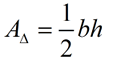
b = length of a side (base)
h = top describe to that side | | The area of ΔABC can be expressed as: 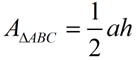
where a represents the side (base)
and h represents the superlative drawn to that side. | 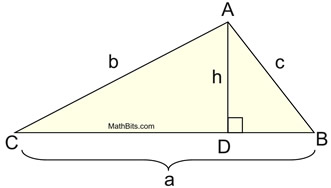 | Using trigonometry, let'due south accept another look at this diagram.
In the right triangle CDA, we tin can state that:

The height, h , of the triangle can be expressed every bit b sin C .
| Substituting this new expression for the summit, h, into the general formula for the area of a triangle gives:
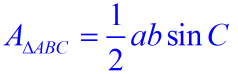
where a and b can be any 2 sides and
C is the included angle. | 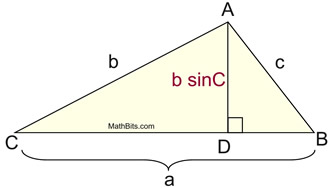 | |  | The area of a triangle can be expressed using the lengths of 2 sides and the sine of the included bending. ExpanseΔ = ½ ab sin C. | | Yous may see this referred to every bit the SAS formula for the area of a triangle. | With this new formula, nosotros no longer have to rely on finding the altitude (height) of a triangle in order to observe its area. Now, if we know ii sides and the included angle of a triangle, we tin can find the area of the triangle. This is a valuable new formula! 
 | Given the triangle at the right, find its expanse. Limited the answer to the nearest hundredth of a square unit. | 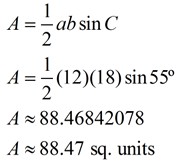 | When using your graphing calculator, be sure yous are in Degree mode, or using the degree symbol. | | 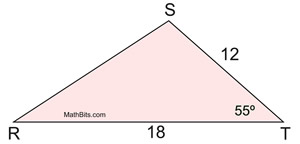
Let a = ST, b = RT, and C = ∠RTS. |
 Given the parallelogram shown at the right, find its area to the nearest square unit of measurement. The diagonal of a parallelogram divides information technology into 2 congruent triangles. And so the total expanse of the parallelogram volition exist TWICE the area of 1 of the triangles formed by the diagonal. This example shows that past doubling the triangle surface area formula, we accept created a formula for finding the expanse of a parallelogram, given ii adjacent sides (a and b) and the included angle, C. 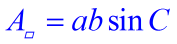
Area of Parallelogram
| 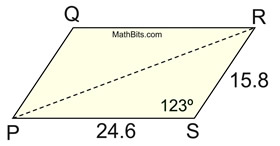
Let a = PS, b - RS, and C =∠PSR.
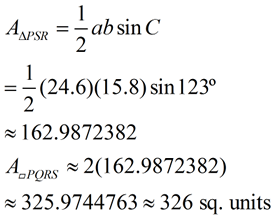
|
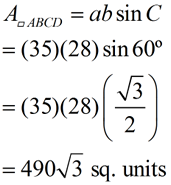
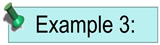 Given the parallelogram shown at the right, observe its EXACT area. If a question asks for an Verbal answer, practise not use your estimator to detect the sin 60º since it will be a rounded value. To go an EXACT value for sin 60º, use the 30º-60º-90º special triangle which gives the sin 60º to be  . .
Notice that we are using the formula for the area of a parallelogram nosotros discovered in Example two. | 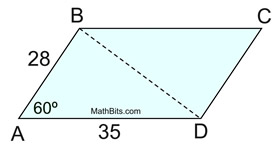
Let a = Advertizing, b = AB, and C = ∠BAD.
| |  | For help with
this formula on
your calculator,
click hither. |
Deriving this formula:
NOTE: The Common Core Standard 1000.SRT.9 states "Derive the formula A = ½ab sin(C) for the surface area of a triangle by drawing an auxiliary line from a vertex perpendicular to the reverse side." This argument can be interpreted as applying only to astute triangles. This site will, however, examine both "acute" and "birdbrained" triangles in deriving the formula. Example 1: Acute Triangle If this formula truly works (and it does!), nosotros should be able to utilize the formula using whatsoever angle in the triangle. Then, when attempting to "derive" this formula, we should evidence that it can be "developed" using any (and every) angle in the triangle. In the example shown higher up, nosotros adult the formula using acute ∠C. The aforementioned approach can be used to establish the human relationship using acute ∠B: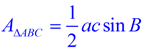 . When ∠A is a tertiary acute bending, we can draw another internal distance (summit) and use this same approach a third fourth dimension, getting: . When ∠A is a tertiary acute bending, we can draw another internal distance (summit) and use this same approach a third fourth dimension, getting: 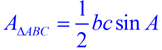 . . Case two: Obtuse Triangle
Can nosotros withal develop this formula if ∠A is an obtuse angle? The answer is "yes", merely it will crave more work and some more trigonometric information. We will accept a brief await at what is involved when ∠A is an obtuse angle, but these concepts will be more fully developed in upcoming courses. Annotation: to maintain the use of a single letter of the alphabet to represent the angle in our formula, nosotros will exist referring to ∠BAC in the diagram below, every bit ∠A. When ∠A is an obtuse angle, the distance drawn from C or B will be outside of the triangle. Draw the altitude from C to the line containing the opposite side. ΔCAE is a right triangle, but unfortunately it does not incorporate ∠A that we need for our formula. | 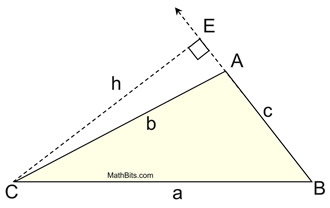 | | We know, however, that ∠CAE is supplementary to ∠A, since they form a linear pair.
We can land that m∠CAE = 180 - m∠A and from ΔCAE that  . .
If we apply a trigonometric fact that sin∠A = sin(180 - thou∠A), we can substitute and get:
 (Subsequently multiplying both sides of the first equation past b.) (Subsequently multiplying both sides of the first equation past b.)
Now, substitution into the general formula for the area of a triangle will give us our desired formula: . | | sin∠A = sin (180 - m∠A)
Recollect that the functions of sine, cosine, and tangent are defined merely for acute angles in a right triangle.
Then, how exercise we find the sine of an obtuse bending? We cannot use the sides of the triangle to find sin∠BAC because the bending does non reside in a right triangle. We can, all the same, discover sin∠BAD which deals with an astute angle in a right triangle. ∠BAD is the supplement of ∠BAC since they form a linear pair. | 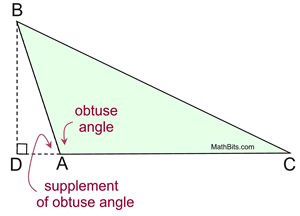 | | The sine of an obtuse bending is defined to be the sine of the supplement of the angle.
Thus, sin∠A = sin (180 - m∠A).
On your graphing calculator, sin(50º) = 0.7660444431 and sin(130º) = 0.7660444431show this fact to be truthful. These angles are supplementary since 50º + 130º = 180º.
| | WHY does sin∠A = sin (180 - m∠A)? This topic will be explored in more detail in upcoming courses.
To sympathize "why" this human relationship is true, nosotros need a coordinate grid. Right triangle DEF is fatigued in quadrant I, as shown. If we draw an angle of 130º, and drop a perpendicular to the x-axis from point H where DH = DF, we will create a reflection of ΔDEF over the y-axis. This reflected triangle (ΔDGH) is congruent to ΔDEF and both triangles have the same lengths for their sides opposite the 50º. Information technology should be noted that both reverse sides deal with positive y-values (designating management to a higher place the 10-axis).
| 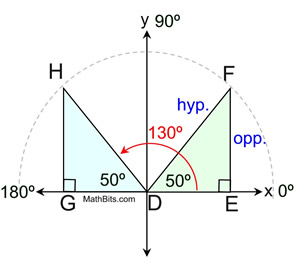
50º and 130º are supplementary.
| | When dealing with obtuse angles (such equally 130º), the respective astute bending (50º) is used to make up one's mind the sine, cosine or tangent of that obtuse angle. This respective acute angle is called a "reference angle". | 
NOTE: The re-posting of materials (in part or whole) from this site to the Internet is copyright violation
and is not considered "fair utilize" for educators. Please read the "Terms of Utilise". |



0 Response to "Is It Possible To Draw A Triangle With Two Obtuse Angles"
Post a Comment